
Efficiency in Focus | Getting to Yes: Convincing Stakeholders to Approve Energy Efficiency Projects
Energy efficiency (EE) projects rarely fail because the technology doesn’t work. More often, they stall because the path to approval is cluttered with budget constraints, competing priorities, complex procurement rules, and stakeholder skepticism. For public agencies, the challenge isn’t proving that EE projects save energy—it’s packaging them in a way that makes them easy to approve, easy to fund, and easy to execute.
The City of Fresno offers a compelling case study in how to prepare large-scale energy efficiency initiatives for approval and streamline real-world implementation. By aligning political priorities, leveraging innovative financing, streamlining contractor procurement, and grounding decisions in robust data, Fresno transformed a sprawling portfolio of facilities into a coordinated, high-impact EE program spanning 76 sites across municipal services, parks, fire, police, and utilities.
This is the story of how Fresno didn’t just say yes to energy efficiency—it made yes the easiest option.
The Scale: One City, 76 Sites, One Unified Vision
The scope of Fresno’s EE initiative was ambitious by any measure. The program encompassed 76 sites across:
The Municipal Service Center
Parks and recreation facilities
Fire stations
Police facilities
Department of Public Utilities buildings
Projects were supported through on-bill financing with PG&E, paired with a 15-year financing agreement with a not-to-exceed rate—an approach that minimized upfront capital cost while providing budget predictability over the life of the improvements.
Every project was designed with a dual mission: improve energy performance and invest in the local workforce. Energy job training and local labor were not side benefits; they were central priorities. This meant the program didn’t just go green, it went smart, delivering environmental wins alongside economic and community benefits that actually mattered to both decision-makers and the people who live there.
Political Alignment: Why Parks, Fire, and Safety Came First
Timing and political context matter. Under Mayor Jerry Dyer’s leadership, Fresno placed parks, fire, and public safety upgrades at the top of its municipal agenda. These were not abstract infrastructure investments, they were highly visible improvements that residents could see, use, and appreciate.
By prioritizing EE projects in these areas, the city created a series of easy wins:
High visibility: Residents notice better-lit parks, safer fire stations, and more efficient public facilities.
Clear public benefit: Energy upgrades were tied directly to safety, comfort, and community well-being.
Measurable savings: These facilities offered strong opportunities for operational cost reductions.
Visible success built political capital. Early wins created a track record that made future projects easier to approve. Stakeholders became comfortable supporting additional initiatives because they could see tangible results.
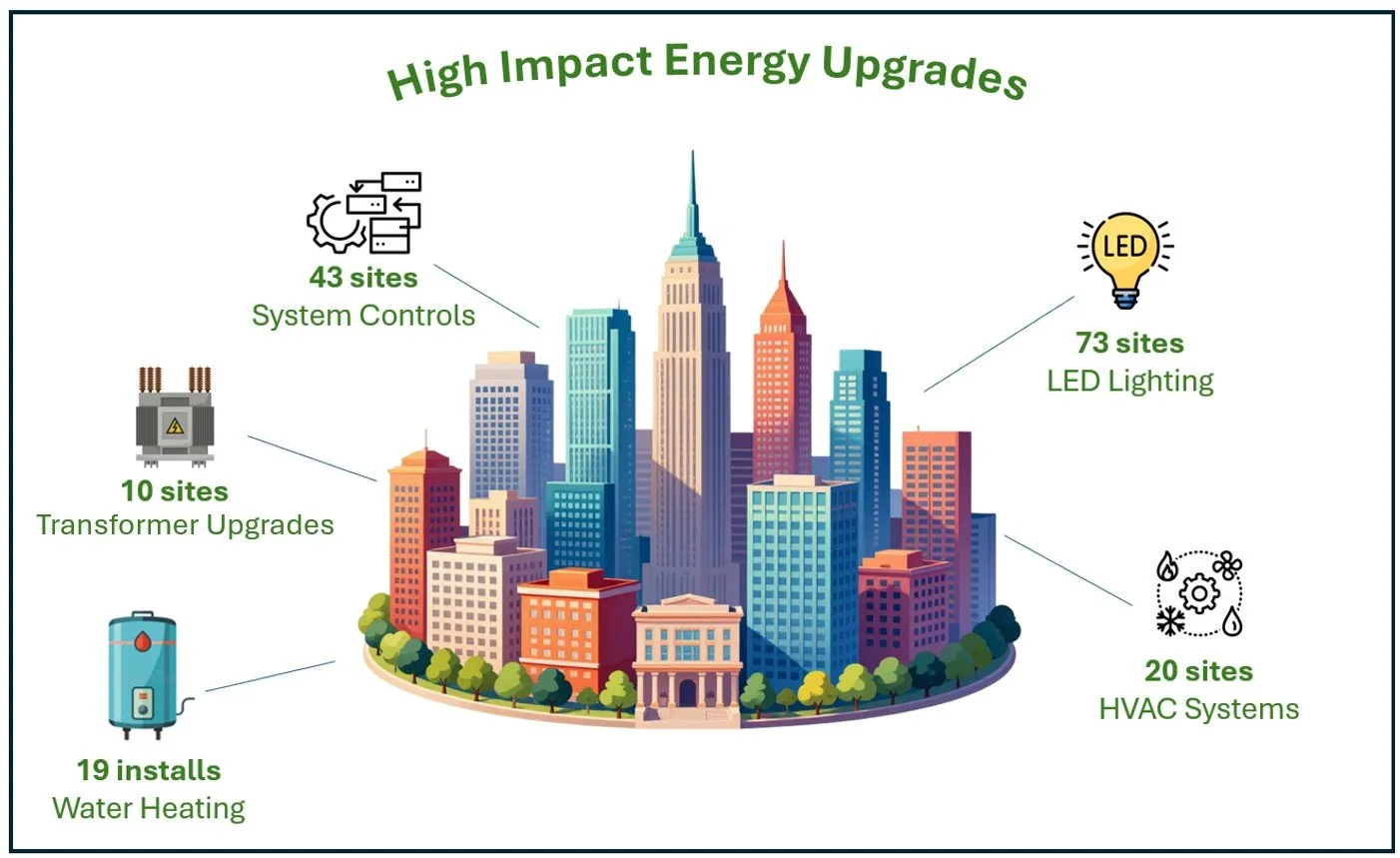
Measures Installed: Tangible Improvements
Making Approval Easy: Know Your Audience
Gaining buy in from all stakeholders from agency partners to the public requires anticipation of their priorities, concerns, potential objections, and other obstacles—and then addressing those before they’ve even surfaced. Fresno deliberately structured its EE projects to meet the criteria that would matter most to everyone involved after extensive workshops and research.
Key elements included:
Predictable financing: The 15-year, not-to-exceed financing agreement eliminated budget surprises.
Clear savings projections: Each project was tied to measurable energy and cost savings.
Standardized contracting: Pre-approved contractors reduced legal review complexity and risk.
Workforce alignment: Local labor and job training made the projects socially and economically appealing.
By framing EE as a standardized, repeatable solution, the City ensured projects could move efficiently through approval channels with minimal friction.
Building the Bench: Pre-Qualified EE Contractors
Streamlining procurement was another critical success factor. Fresno issued multiple requests for qualifications (RFQs) to develop a bench of eligible and vetted energy efficiency service firms for on-call projects, including energy efficiency and renewable energy. One key partner in these efforts was Alliance Building Solutions, Inc. (ABS), which provided project management, technical support, and contractor coordination to accelerate project deployment.
Benefits of this approach included:
Accelerated project timelines
Reduced administrative overhead
Consistent quality and compliance
Lower perceived risk for decision-makers
With these firms established, departments could move quickly from concept to implementation without navigating the full procurement cycle each time.
SJVCEO’s Role: The Data Backbone
The San Joaquin Valley Clean Energy Organization (SJVCEO), through the PG&E-funded Central California Energy Watch (CCEW), benchmarked nearly the City’s entire utility portfolio in 2019, excluding streetlights. Over 1,000 accounts were analyzed, and findings were presented in a nine-chapter Energy Readiness Report organized by NAICS code.
SJVCEO’s contributions included:
Identifying prime opportunities for energy savings
Assessing site eligibility for the Willdan Government and K–12 (GK-12) Program
Handling benchmarking paperwork and site access logistics
This data-driven approach enabled Fresno to prioritize projects with the greatest potential impact and minimal administrative friction.
Stakeholder Alignment: Speaking the Same Language
Gaining stakeholder buy-in began with identifying shared objectives between elected officials and the communities they serve. Fresno discovered the two primary shared goals:
Reduce taxpayer costs through lower utility bills
Improve air quality via greenhouse gas (GHG) reductions
By framing projects around these priorities, the City made approval straightforward. When elected officials understood that the EE program aligned directly with both fiscal responsibility and public health, support came naturally.
Lessons for Replication
Other public agencies can replicate Fresno’s success by focusing on three key principles:
Understand stakeholder goals: Align projects with elected officials’ priorities.
Know your approval process: Structure projects to move efficiently through approval channels.
Build repeatable systems: Pre-qualified contractors, standardized contracts, and robust benchmarking reduce complexity and risk.
By combining data-driven decisions with visible results and clear alignment to political and community priorities, EE initiatives become much easier to implement.
Why This Model Works
At its core, Fresno’s success stems from reducing the risk perceived. Every element of the program—financing, procurement, benchmarking, workforce alignment—answered the unspoken questions that often stall public projects:
Will this cost more than expected? → Not-to-exceed financing agreements ensure predictability.
Will it require complex approvals? → Standardized packages and consent-ready documentation streamline the process.
Will it deliver results? → Backed by benchmarking and energy audits.
Will it benefit the community? → Visible upgrades and local workforce investment.